


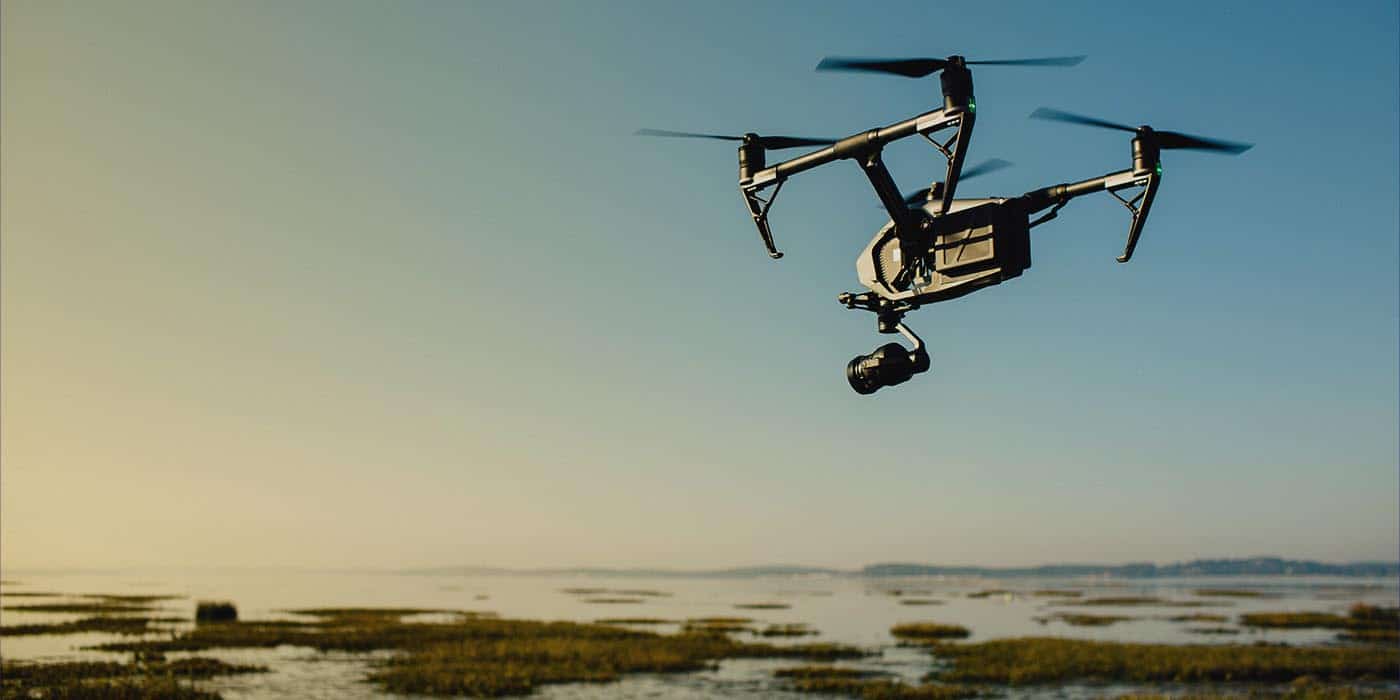
We recently added a new drone to our fleet—the DJI Mavic—which opens a new range of possibilities for aerial videography.
It’s smaller, lighter and simpler to use, yet still captures beautiful footage at 4k resolution. Running Pony Director of Photography (DP) Ryan Goble, one of our three licensed drone pilots, explains: “It’s very nimble. It’s easier to fly in close-quarters, like inside, or through doorways or windows. So it’s great for flying inside a warehouse, a factory, arenas, office buildings, and homes.” Unlike other drones that might require both a pilot and a camera operator, the Mavic can be operated by just one person. The blades, or props, are smaller and lighter. “And you can put ‘prop guards’ on them,” says Ryan, “so, God forbid, if you bump something, it won’t do any damage.”

It’s a far cry from the first drone we purchased about 7 years ago, when the technology was still new. It was much larger and required two people to fly. Yet, on the very first shoot with the drone, we used it to film mountain bikers speeding through narrow, tree-lined trails in the Colorado Rockies. Our next drone, purchased a few years later, was smaller and allowed even more challenging shoots…like the one where we had to simulate a golf ball flying through the air and making a hole-in-one. “We had the drone take off from the green at full speed, fly up 100 feet, then basically fall but stop 3 feet above the cup,” Ryan recalls. “It took 32 takes, but we got the shot, and it looked amazing.” Ryan also used the drone later to capture shots for a Dodge Ram truck commercial that aired during the 2018 Super Bowl.
Now, new technology and smaller drones like the Mavic, are allowing aerial shots that weren’t possible before now. Sophisticated sensors allow drone “swarms” to fly in synchronicity, forming words, patterns, or symbols in the sky—as seen recently during this year’s Super Bowl and the U.S. presidential inauguration. And “first person view” (FVP) technology allows a drone pilot wearing goggles to do things like fly a drone at full speed through a bowling alley, or fly steadily alongside a race car at high speeds. But it’s not just about the technology; the key is how to use the technology to tell a client’s story in a compelling way. “Where our skill comes in,” says Ryan, “is understanding camera movement, how to make drone footage look cinematic and interesting, and to constantly figure out a new and different way to get the ‘perfect shot.’”
Where our skill comes in is understanding camera movement, how to make drone footage look cinematic and interesting, and to constantly figure out a new and different way to get the ‘perfect shot.’
Ryan Goble, Licensed Drone Operator and DP
If you need aerial footage for your next project, give us a call and we’ll handle all the details. Our DPs are all licensed drone pilots, and we are one of the few production companies in this region that are authorized to fly at night. A certified professional with extensive experience both as a pilot and a camera operator can make all the difference. As Ryan point outs, “Anyone can fly a drone. They’re very easy to fly. But also easy to crash.”

